Developer Offer
Try ImaginePro API with 50 Free Credits
Build and ship AI-powered visuals with Midjourney, Flux, and more — free credits refresh every month.
ChatGPT Helps Dental Students Master Complex Anatomy
The Challenge for International Students in Medicine
As higher education becomes more global, many students find themselves learning in a language that isn't their native tongue. This is especially common through English-medium instruction (EMI), where subjects are taught in English in non-Anglophone countries to boost international competitiveness. While this opens up opportunities, it also creates hurdles, particularly in highly specialized fields like health and medicine. For these students, mastering complex subjects means learning a new language and dense technical terminology simultaneously. This is a significant challenge in dental education, where a precise understanding of terms in subjects like oral anatomy is the foundation for all future clinical skills.
In Malaysia, a growing hub for international education, universities like SEGi University see a large number of students from countries like China. These students often face linguistic barriers that can impact their academic success. Traditional learning aids like glossaries are helpful but often fail to provide the real-time, interactive support students need.
Can AI Bridge the Learning Gap
This is where artificial intelligence, specifically large language models like ChatGPT, shows incredible promise. AI can act as a digital scaffold, helping multilingual students by simplifying complex terms, providing context, and answering questions in a private, judgment-free environment. This approach can reduce the mental effort, or cognitive load, required to process both language and new concepts, allowing students to focus on the core subject matter. Furthermore, by giving students a tool they can use on their own terms, AI promotes autonomy and self-directed learning, which are key drivers of motivation according to Self-Determination Theory.
However, the use of AI in education isn't without its risks. Concerns about overreliance, the accuracy of AI-generated information, and data privacy are valid. To be effective, AI tools must be integrated into the curriculum with clear faculty guidance and ethical oversight. This study aimed to explore both the benefits and the challenges of using ChatGPT to help international dental students overcome language barriers in their anatomy course.
How the Study Worked
To test the impact of AI-assisted learning, researchers conducted a pilot study with 35 first and second-year international dental students from China at SEGi University in Malaysia. The study used a mixed-methods approach, combining quantitative data (test scores and surveys) with qualitative data (usage logs and focus groups) to get a complete picture.
The eight-week study was structured in three phases:
- Pre-Intervention: Students took a baseline test on oral anatomy terminology and completed a survey to measure their engagement. They also received an orientation on how to use ChatGPT effectively and ethically, with a focus on academic integrity and data privacy.
- Intervention: For eight weeks, students used ChatGPT during their self-directed study time to ask questions, clarify terms, and explore concepts related to their coursework. They logged their interactions to track usage patterns.
- Post-Intervention: Students retook the terminology test and engagement survey. Researchers also conducted focus group discussions to understand the students' experiences, including the perceived benefits, challenges, and any ethical concerns that arose.
The Results Are In ChatGPT Makes a Big Impact
The findings showed a clear and significant improvement in student performance and engagement. Terminology comprehension scores jumped from an average of 10.4 out of 20 before the intervention to 16.1 afterward. This represents a substantial improvement in their understanding of complex anatomical terms.
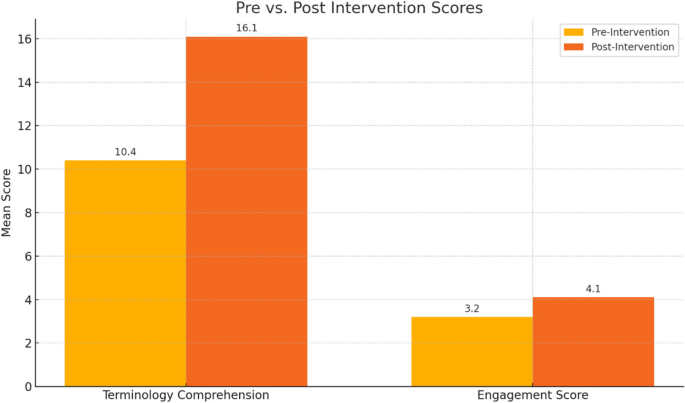
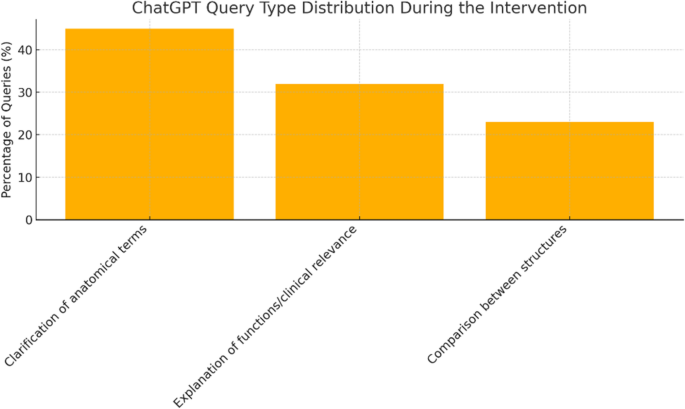
Student engagement also saw a significant boost. Surveys measuring vigor, dedication, and absorption in their studies showed higher scores after using ChatGPT. Analysis of usage logs revealed how students used the tool. The most common queries were for clarifying terms (45%), explaining functions (32%), and comparing anatomical structures (23%). Students asked questions like, “What is the difference between enamel and cementum?” and “Can you explain the role of the trigeminal nerve in tooth sensation?”
What Students Really Thought The Pros and Cons
Focus group discussions revealed four main themes about the student experience:
-
Clarity and Confidence: Students felt that ChatGPT helped them understand difficult terms, which made them more confident and willing to participate in class. One student noted, “ChatGPT helped me learn words that I didn’t understand in class, and I felt less scared to ask questions later.”
-
Self-Directed and Personalized Learning: Students valued the autonomy of using AI as a personal tutor. One participant said, “I liked that I could ask the same question multiple times and get better explanations each time.”
-
Concerns About Accuracy and Over-reliance: While the feedback was overwhelmingly positive, students also showed a healthy skepticism. They raised concerns about becoming too dependent on the tool and noted that some AI-generated answers were too general or not entirely accurate, highlighting the need for critical thinking.
-
Ethical and Privacy Awareness: The initial briefing on ethics was effective. Students were mindful of data privacy and the importance of cross-checking information. “Even though we were told it was safe, I still avoided typing anything too personal into ChatGPT—just to be careful,” one student shared.
The Bigger Picture A Hybrid AI Human Future for Education
This study provides strong evidence that AI tools like ChatGPT can be powerful aids for linguistically diverse students in demanding fields like dentistry. By reducing language-based cognitive load and fostering autonomy, AI supports established learning theories and leads to better academic outcomes and higher motivation.
However, the findings also underscore that AI is a supplement, not a substitute, for traditional education. The ethical concerns raised by students—accuracy, overreliance, and privacy—are critical. The success of AI in education hinges on a hybrid approach where faculty provide guidance, model critical thinking, and ensure the technology is used responsibly.
For educational institutions, this means developing clear policies and providing training for both students and faculty on AI literacy. As AI becomes more integrated into our world, it's essential to ensure it is deployed in a way that is pedagogically sound, ethically responsible, and ultimately enhances human learning.
Compare Plans & Pricing
Find the plan that matches your workload and unlock full access to ImaginePro.
| Plan | Price | Highlights |
|---|---|---|
| Standard | $8 / month |
|
| Premium | $20 / month |
|
Need custom terms? Talk to us to tailor credits, rate limits, or deployment options.
View All Pricing Details